

ROI for wind and hybrid energy projects is calculated by comparing the net financial gain from the project with the total investment. The basic formula is:
ROI (%) = (Net Gain ÷ Total Investment) × 100
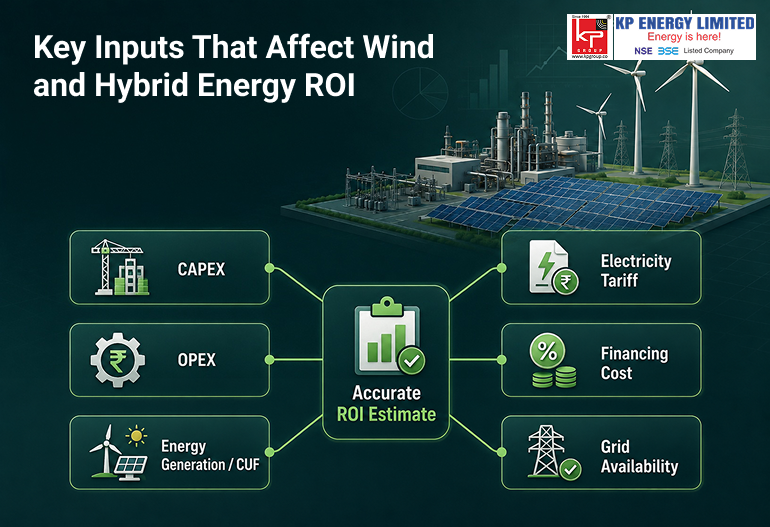
For wind and hybrid energy projects, ROI calculations should account for more than just installation costs and electricity savings. Key factors include capital expenditure (CAPEX), operating and maintenance costs (OPEX), energy generation, electricity tariffs, financing costs, incentives, grid availability, system performance, and the expected project lifespan.
While ROI provides a useful measure of profitability, most facility owners also evaluate metrics such as payback period, net present value (NPV), and internal rate of return (IRR) to gain a more complete understanding of project viability.
For facility owners and energy managers, understanding the ROI for wind and hybrid energy is paramount to ensure that the investment made in such projects yields a direct return on investment.
Whether you are evaluating separate wind energy solutions or a hybrid combination of renewable energy systems, a thorough understanding of the concept of calculating ROI for wind energy helps in the longer run.
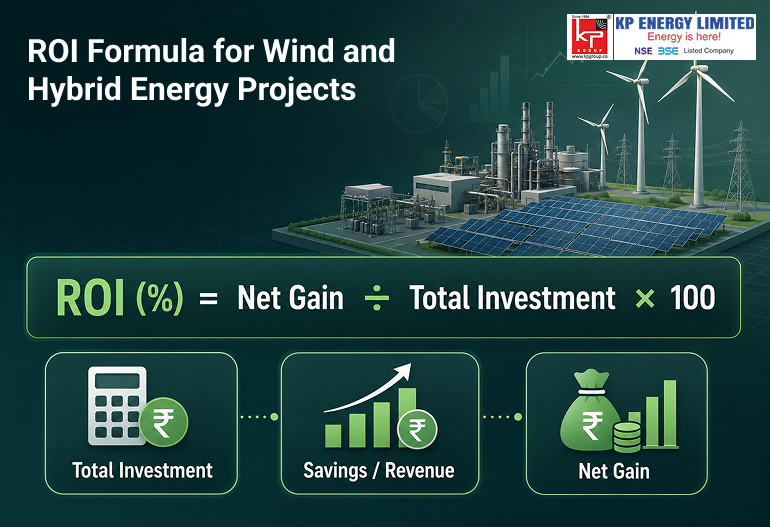
ROI measures the financial return generated from a wind or hybrid energy project compared with the capital invested. It helps facility owners compare project cost, savings, revenue, payback period, and long term financial viability.
ROI (%) = [(Total Savings or Revenue – Total Costs) ÷ Total Investment] × 100.
Different from generic ROI calculations, wind and/or hybrid project ROIs must take into account variables specific to energy infrastructure, things like fluctuating energy yields, maintenance costs, and incentives offered such as renewable energy credits or tax benefits.
All this becomes even more complex with the ROI for hybrid energy systems. A hybrid energy system financial analysis considers not just the output of wind turbines but their integration with solar, storage, or other renewable sources.
This way, it is assured that energy production reliability, cost savings, and capital efficiency will all be quantified to give the stakeholders a clear picture of the financial viability.
Understanding such kinds of ROIs helps facility managers justify the upfront costs and anticipate the benefits long afterwards.
ROI (%) = (Net Gain ÷ Total Investment) × 100
Calculating ROI for wind energy considers tangible and intangible aspects affecting returns. A step by step procedure would look like:
|
Input |
What to Check |
Why It Matters |
|
CAPEX |
Cost of turbines, civil works, installation, land, grid connection, permits, and commissioning |
Determines the total upfront investment and has the biggest impact on payback and ROI. |
|
OPEX |
Annual maintenance, repairs, insurance, monitoring, land lease, and other operating expenses |
Lower operating costs improve long term profitability and overall returns. |
|
Capacity Utilisation Factor (CUF) |
Expected annual energy generation based on wind resource, turbine performance, and site conditions |
Higher CUF increases electricity generation and improves project economics. |
|
Electricity Tariff |
Applicable grid tariff, feed-in tariff, or avoided electricity cost |
Determines the financial value of every unit of electricity generated. |
|
Contract duration, tariff structure, escalation clauses, and payment terms |
Provides revenue certainty and affects long term cash flow projections. |
|
|
Financing Cost |
Interest rates, loan tenure, debt-to-equity ratio, and repayment schedule |
Financing expenses influence project cash flows and overall investment returns. |
|
Grid Availability |
Reliability of grid connectivity and the risk of curtailment or evacuation constraints |
Limited grid availability can reduce energy exports and lower revenue. |
|
Operation & Maintenance (O&M) |
Scope of maintenance contracts, service frequency, spare parts availability, and warranties |
Effective O&M helps maximise energy generation while reducing unexpected downtime. |
|
Incentives |
Government subsidies, accelerated depreciation, generation based incentives, renewable energy certificates, or state specific benefits |
Incentives can significantly improve project viability and shorten the payback period. |
|
Tax Treatment |
Depreciation benefits, GST implications, corporate tax provisions, and other applicable tax incentives |
Tax benefits can improve net project returns and influence the effective ROI. |
For accurate ROI estimation, facility owners can work with experienced EPCC services/BOP partners for feasibility studies, engineering, procurement, construction, commissioning, and long term execution planning.
Hybrid energy systems combine wind, solar, and often battery storage to improve energy reliability and maximise renewable energy utilisation. While this offers greater flexibility than a standalone wind system, it also makes ROI calculations more complex.
Unlike standalone wind projects, hybrid ROI requires:
Combined modelling of wind generation
Battery storage
Grid imports and exports
Facility's electricity demand profile.
Rather than evaluating each asset separately, the financial performance depends on how these technologies interact to optimize energy production, consumption, and costs over the project's lifetime.
Key Steps for hybrid energy system financial analysis:
Capital and Operating Costs in Aggregated Form: Consider all cost elements such as turbine, solar panels, batteries, inverters, and control.
Predict Energy Production: Model production from diverse sources, incorporating synergetic effects. The presence of stable hybrid systems will lead to fewer days with zero energy production and can enhance returns on investment.
Quantify savings or revenues: This may include calculation of collective energy savings, or revenue streams from feed in tariffs or grid benefits.
Perform a Sensitivity Analysis: Use the tool to determine the effect of a price change, maintenance, or degradation on the return on investment (ROI).
An effective financial analysis of a hybrid energy system helps investors and all other related stakeholders have a clear understanding of payback periods and IRR with regard to financial sustainability.
Installation of hybrid technology increases ROI for facilities investing in such systems when contrasted with standalone systems, depending on regional availability of variable resources.
Cost benefit analysis for wind projects is a method that can bridge the assessment gap of wind projects. By identifying the potential cost and benefit of the project, the analysis can determine whether the investment is worthwhile.
|
Step |
What to Evaluate |
Why It Matters |
|
Capital and Operational Costs |
Establish the cost baseline, covering both initial capital expenditure and ongoing operational costs |
Sets the foundation for every downstream calculation, since accurate returns depend on a correct cost baseline. |
|
Energy Production Forecasts |
Estimate annual energy production and peak capacity using resource and turbine performance data |
Determines the revenue side of the equation, so forecast accuracy directly affects the reliability of return calculations. |
|
Financial Metrics for Wind Farms |
Calculate payback period, Levelized Cost of Energy (LCOE), Net Present Value (NPV), and ROI |
Provides a standardised way to compare project viability and benchmark performance against other investments. |
|
External Factors Affecting ROI |
Account for tax credits, grants, and other policy-driven incentives |
Can materially improve project economics and shorten payback, so overlooking them understates true returns. |
Cost benefit analysis when combined with ROI analysis enables the determination of high performing projects. The benefit of the procedure is that it ensures power plants can estimate profitability.
This allows the incorporation of renewable energy projects into the financial strategy.
Payback period measures how long it takes for the savings or revenue generated by a project to recover its initial investment. It is one of the most commonly used financial metrics for evaluating renewable energy projects because it indicates how quickly the investment begins generating net financial benefits.
For facility owners and energy managers, understanding the payback period helps determine whether a wind or hybrid energy project aligns with investment goals and budget expectations.
For wind and hybrid projects, payback period does depend on a number of factors:
Initial Capital Costs: Higher upfront CAPEX results in a longer payback, while smart equipment choices have the opposite effect.
Energy Yield: A site with a good, consistent wind/hybrid potential will have faster ROI due to the higher energy yield.
Operational Costs: The reduced OPEX due to efficient maintenance operations and intelligent management reduces the payback time of this investment.
Income and Incentives: Feed in tariffs, renewable energy credits, and the cost of avoided usage have a direct effect on the payback term.
Generally speaking, an independent wind project may reach break-even points within 5-8 years, but an apt optimization of a hybrid model consisting of wind, solar, and energy storage could give slightly earlier payback times due to a stabilized power output.
Estimations of investment returns for renewable energy facilities enable different parties to budget accordingly.
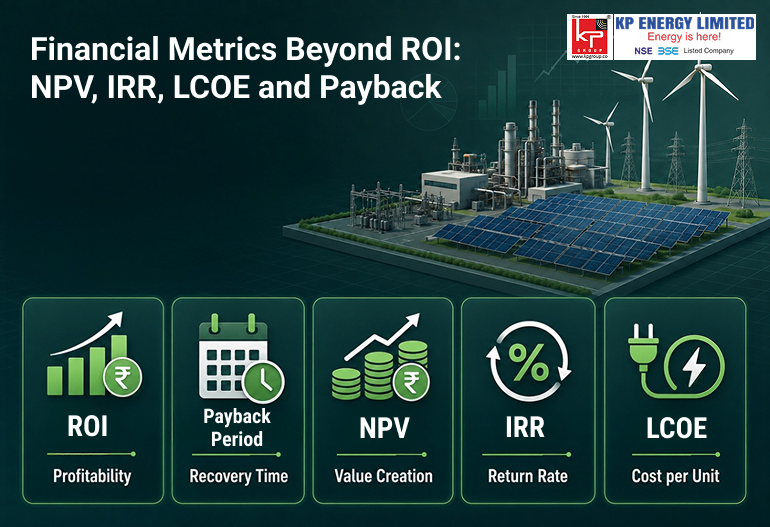
ROI is an important indicator of a project's financial viability, but it should not be evaluated in isolation. Renewable energy investments are typically assessed using a combination of financial metrics that measure profitability, cash flow, financing risk, and long term performance.
|
Metric |
What It Measures |
Why It Matters |
|
Return on Investment (ROI) |
The percentage return generated relative to the total investment. |
Provides a high level measure of project profitability. |
|
Net Present Value (NPV) |
The present value of all future cash flows after accounting for the time value of money. |
Indicates whether the project is expected to create value over its lifetime. |
|
Internal Rate of Return (IRR) |
The discount rate at which the project's NPV equals zero. |
Helps compare investment opportunities with different costs and cash flow profiles. |
|
Project IRR |
The return generated by the project before considering financing. |
Measures the inherent financial performance of the renewable energy asset. |
|
Equity IRR |
The return earned by equity investors after accounting for debt financing. |
Shows the actual return received by project owners and investors. |
|
Debt Service Coverage Ratio (DSCR) |
The ratio of available cash flow to annual debt repayment obligations. |
Indicates whether the project generates sufficient cash flow to service its loans. |
|
Levelized Cost of Energy (LCOE) |
The average lifetime cost of producing one unit of electricity. |
Enables comparison between different renewable energy technologies and conventional power sources. |
|
Payback Period |
The time required for cumulative savings or revenue to recover the initial investment. |
Shows how quickly the investment is expected to recover its costs. |
|
Debt Tenure |
The duration over which project loans are repaid. |
Influences annual debt obligations, project cash flow, and investor returns. |
|
Tariff Escalation |
Expected changes in electricity tariffs or contracted power prices over time. |
Affects future revenue and long term project profitability. |
|
Sensitivity Analysis |
Evaluates how changes in key assumptions, such as energy generation, tariffs, financing costs, or O&M expenses, affect financial outcomes. |
Helps assess project risk and understand how resilient returns are under different scenarios. |
By evaluating these metrics together, facility owners, investors, and lenders gain a more complete understanding of a renewable energy project's financial performance.
Combining ROI with measures such as NPV, IRR, DSCR, LCOE, and sensitivity analysis enables more informed investment decisions and provides a clearer picture of long term project viability.
In hybrid energy systems, energy efficiency and ROI for hybrid systems basically coincide. There is a direct relationship between optimizing energy production patterns and wind energy investment returns. Such measures include:
Smart Load Management: Managing energy demand and supply helps to cut energy waste and maximize net savings.
Integrated Storage Solutions: Batteries or hybrid solutions could be used to store additional power and provide reduced dependence upon utility supplied electricity, increasing ROI. Batteries or hybrid solutions could be used
Routine Maintenance & Efficiency Levels: Optimal efficiency with turbines, sun panels, or inverters can maximize production.
Energy Optimization Software: Advanced analytics capabilities enable forecasting and optimization of power output that can meet demand, thus increasing profitability.
It not only reduces the payback period, but it also increases profitability in the long run, and hence, it is an attractive technology for facilities when considering ROI.
The calculation of Return on Investment (ROI) for wind & hybrid energy is a robust decision making tool. By grasping the payback time for wind energy and making an assessment of the financial performance of renewable energy schemes, one can make well informed decisions.
Proper calculation of ROI will determine the most profitable forms of renewable energy, estimate investment return and payoff periods and increase efficiency of operation for sustainability.
Furthermore, a sound knowledge of the ROI means that expenses related to wind or hybrid power facilities will not only be friendlier to the environment but will also be a financially viable option for facilities.
What are the key factors affecting ROI for wind and hybrid energy projects?
Capital expenses, operating expenses, energy production, site factors, incentives, and efficiencies of systems can all affect ROI.
How do you calculate the payback period for wind and hybrid energy projects?
Payback Period = Initial Investment / Annual Savings or Revenue; Smaller payback periods show faster ROIs.
What is the typical ROI for wind energy investments?
The ROIs of wind energy projects lie between 10% and 30%, depending on multiple factors like site, CAPEX, OPEX and incentives.
How does financial performance impact ROI calculations for renewable energy projects?
Combining ROI with measures such as NPV, IRR, DSCR, LCOE, and sensitivity analysis enables more informed investment decisions and provides clearer forecast numbers of long term project viability.
What role does cost-benefit analysis play in determining ROI for wind and hybrid projects?
Determining ROI cost benefit analysis allows for comparison of cost and benefit measurement and can help estimate returns on investment.