
India's renewable energy growth has accelerated dramatically. Wind and hybrid projects are moving from being technically and commercially viable to becoming strategically important for energy planning. But the investment model you choose matters far more than most realize. It shapes financing, risk allocation, cash flow visibility, and long term project economics over a 20-25 year project life.
The question is simple: Do you buy the wind farm, or do you rent the power it produces?
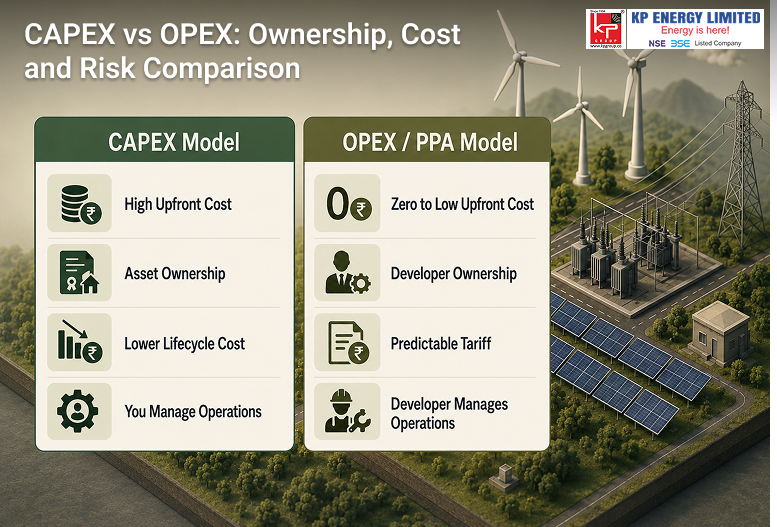
CAPEX requires upfront investment and asset ownership, while OPEX allows customers to buy renewable power through a long term contract without owning the project.
CAPEX (Capital expenditure in wind projects) refers to the upfront investment made to own a wind or hybrid energy asset.
Under OPEX (Operational expenditure), a developer owns and operates the project, while the consumer pays for the electricity consumed under a long term power purchase agreement.
In the case of both wind and hybrid projects, it is significant because these types both involve capital intensive projects with a gestation period as they are dependent on natural variability with their performance.
CAPEX means full ownership of the renewable energy project. The owner funds and owns assets such as:
Land or land use rights
Wind turbines and towers
Foundations, internal roads and civil works
Solar modules, mounting structures and inverters
Battery energy storage systems
Substations, transmission lines and grid connections
Evacuation infrastructure
Project approvals and permits
Operations and maintenance planning
Hybrid projects can benefit from complementary wind and solar generation, which may improve renewable power availability and asset utilisation.
Turbines and components, civil works, land, grid connectivity, EPC services, solar and battery systems.
Lower long term levelized energy costs
Full control over operations and maintenance
Access to applicable tax depreciation benefits
Ownership of the project assets
Better integration of wind, solar and storage systems
CAPEX is generally suitable for businesses with sufficient capital, technical expertise and long term energy requirements. Hybrid projects require coordinated planning across generation, storage, grid connectivity and operations.
OPEX inverts the model. Developer finances, builds, owns, operates. You pay for the service. This has gained popularity in the commercial and industrial (C&I) segment, that wants renewable power without large upfront capital expenditure.
The OPEX model for renewable energy:
Developer bears upfront costs. You sign a 15 to 25 year Power Purchase Agreement. You pay per unit consumed. Developer manages maintenance and risk.
Why C&I companies choose OPEX:
Zero capital outlay. Stable tariffs. Reduced technology and O&M risk for the consumer. Faster deployment. Balance sheet optimization.
For hybrid energy systems, the appeal is:
Developer manages wind, solar, and storage complexity. You get reliable power without ownership.
The cost:
Long term tariffs may exceed CAPEX ownership. You're locked into contracts. No control over technology choices.
Wind power project financing operates on different principles depending on your model, the financing approach changes because CAPEX is asset led, while OPEX is contract led.
CAPEX financing is asset backed.
You raise debt and equity against physical assets you'll own. Lenders evaluate wind resource, land tenure, PPAs, and EPC contractor quality. They're financing concrete and steel. Equity investors focus on long term cash flows and IRR.
OPEX financing is PPA backed.
Developer finances against the PPA revenue stream. Buyer's credit quality becomes paramount. Lenders assess execution capability, not asset value.
Hybrid energy project financing models add complexity. Wind and solar generation patterns must be modelled together. Battery storage introduces additional variables. Lenders need to understand complementary generation and multi technology O&M.
Core difference:
CAPEX lenders evaluate hardware. OPEX lenders evaluate the revenue contract.
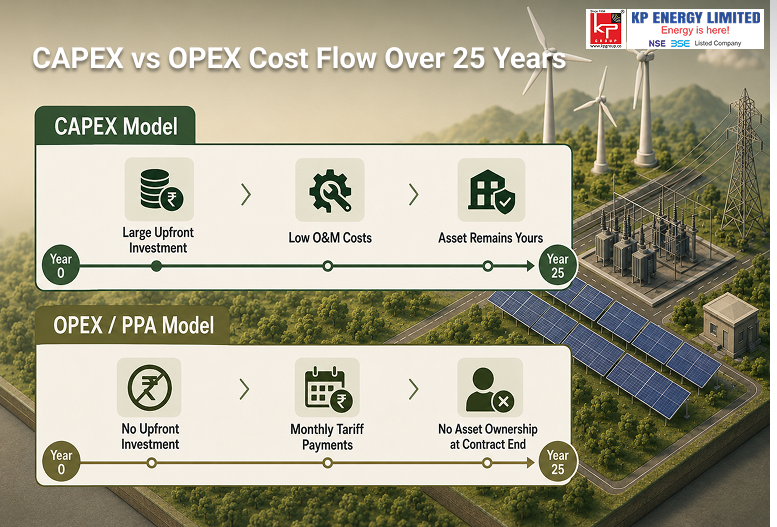
|
Phase |
CAPEX |
OPEX |
|
Development & EPC |
Developer pays large upfront capital |
Developer pays, cost is financed |
|
Construction |
Major cost concentration |
Included in developer's capital raise |
|
Years 1 to 5 |
Low O&M costs, you own asset |
Monthly tariff payments begin |
|
Years 5 to 25 |
Continued low O&M, high cumulative returns |
Tariff payments continue, predictable |
|
End of contract |
Asset remains yours, can be repowered or sold |
Contract ends, no asset remains |
Under CAPEX, success begins with design. Turbine selection, layout, evacuation routing impact capital and efficiency. Proactive maintenance protects returns.
Hybrid projects need integrated planning: wind, solar, and storage must function as one system.
OPEX demands different discipline. Revenue spans decades. Small inefficiencies compound into losses. The model rewards consistent execution.
OPEX vs CAPEX in energy projects requires different philosophies. OPEX emphasizes predictability. CAPEX emphasizes optimization.
Hybrid projects need both. Renewable energy financial strategies succeed when matched to model strengths.
|
Factor |
CAPEX |
OPEX |
|
Upfront Cost |
High |
Zero to Low |
|
Asset Ownership |
You own |
Developer owns |
|
Long term Cost |
Potentially lower lifecycle cost |
Predictable PPA tariff |
|
Operations |
You manage |
Developer manages |
|
Risk Exposure |
Weather, tech, maintenance |
Tariff certainty, contract lock in |
|
Tax Benefits |
Depreciation, credits |
None |
|
Best For |
Large companies, IPPs, utilities |
C&I, startups, capital constrained |
Effective capital and operational cost management in energy projects effectively is indeed the point at which theory becomes practice.
In projects with high CAPEX investments, cost optimization should also begin with design. Decisions regarding turbine selection, layout, and evacuation design may have a potentially significant impact on both capital expenditure and future efficiency. After that, proactive maintenance and monitoring activities can go a long way in helping to safeguard financial returns.
In an OPEX model, the attention is given to the efficiency of life cycles. As far as revenues are concerned, they are generated over several years, and if there are minor inefficiencies in an operation, it can lead to significant losses. A look at the energy models of CAPEX and OPEX from a management standpoint will highlight that CAPEX encourages those who are smart and visionary, whereas OPEX encourages those who are consistent.
Hybrid projects need both. They need investment discipline during the development phase and operational discipline throughout their entire life cycle, so integrated planning is a non-negotiable requirement for such projects.
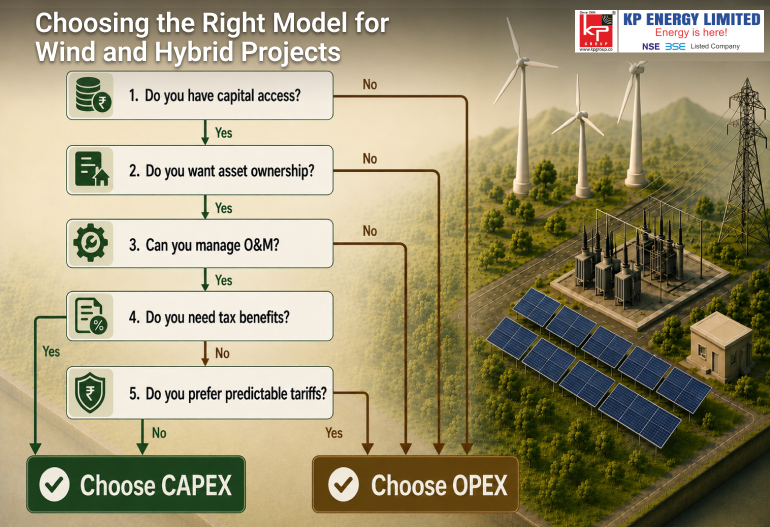
The CAPEX vs OPEX models for wind & hybrid projects is a question of:
Do I have capital access?
Do I want long term ownership?
Can I manage operations?
Do I need tax benefits?
What's my risk appetite?
Choose CAPEX if:
Capital available, want ownership, can manage operations, seek asset appreciation.
Choose OPEX if:
Capital constrained, want operational simplicity, prefer predictable costs.
What is the difference between CAPEX and OPEX in wind and hybrid projects?
Capex involves upfront investments in which the developer or consumer owns the wind or hybrid asset, whereas equipment, construction, and grid infrastructure are all owned. OPEX is a service based model whereby energy is bought over time with predictable tariffs; ownership or operational responsibility stays with the developer.
How does CAPEX affect the financing of wind power projects?
CAPEX financing is assetbacked. Lenders evaluate wind resource, land rights, PPAs, and contractor quality. You raise debt and equity. Risk and returns are yours.
What role does OPEX play in managing renewable energy systems?
OPEX transposes the risk associated with performance and maintenance to the project owners. To consumers, it becomes easier for them to adapt to renewable energy sources, as the initial investment cost is turned into an operational cost.
How do CAPEX and OPEX models influence the cost structure of hybrid energy projects?
CAPEX concentrates costs upfront, then low recurring O&M. OPEX spreads costs evenly through tariff payments. Hybrid projects increase upfront CAPEX but provide more flexible output.
What are the benefits of understanding CAPEX vs OPEX for energy project financing?
A thorough grasp of CAPEX OPEX models allows developers, investors, and energy consumers to harmoniously align funding plans based upon risk budgets, budgetary priorities, and long term sustainable visions, cumulating in more robust and financially sustainable projects for the renewable sector.