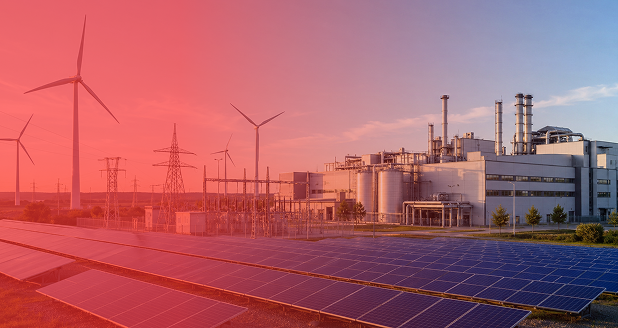
A hybrid wind solar energy system combines solar photovoltaic panels, which primarily generate electricity during daylight hours, with wind turbines that may continue producing power during evenings, nights, early mornings and windy or monsoon periods.
For manufacturing facilities that require electricity around the clock, this complementary generation pattern can provide a more stable renewable power supply than standalone solar or wind projects.
However, achieving genuinely uninterrupted 24×7 renewable power for manufacturing also depends on:
Wind and solar resource availability
Industrial load patterns
Forecasting and dispatch systems
Battery storage or backup arrangements
Grid infrastructure reliability
Plant design and operational management
KPI Green Energy, a renewable energy developer under KP Group, supports hybrid wind and solar projects for grid-connected and captive industrial applications. These projects help industrial consumers access cleaner, more predictable power while contributing to India’s renewable energy ambitions for 2030.
|
Area |
Project Approach |
Industrial Benefit |
|
Renewable sources |
Solar PV combined with wind generation |
More balanced generation across different hours |
|
Industrial model |
Captive Power Producer model |
Renewable electricity supplied directly to industrial consumers |
|
Project example |
7.80 MW wind-solar hybrid system for a manufacturing client in Surat |
Customised renewable power for factory operations |
|
Project scope |
Land, design, civil works, electrical systems, evacuation and commissioning |
Single point project execution |
|
Larger project capability |
Hybrid orders including 145.20 MW wind and 50 MW solar |
Demonstrates scalability for large industrial demand |
|
Operations |
Forecasting, monitoring, scheduling and dispatch |
Better alignment between generation and factory loads |
|
Cost impact |
Lower dependence on grid and diesel power |
Improved long term energy cost predictability |
Several technical and commercial features make hybrid renewable energy suitable for manufacturing plants.
Solar and wind resources often generate electricity at different times.
Solar power is strongest during daylight hours, while wind generation may become stronger:
During evenings
At night
In the early morning
During monsoon periods
In coastal or high wind regions
This natural complementarity reduces some of the supply fluctuations associated with using only one renewable source.
As a result, hybrid power generation for factories can offer greater generation stability across different hours and seasons.
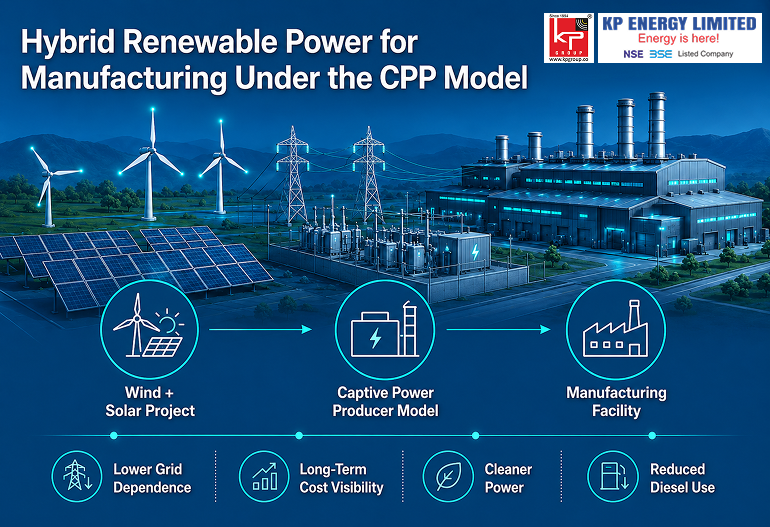
KPI Green Energy has developed hybrid projects under the Captive Power Producer model.
Under this structure, electricity generated by the project can be supplied directly to industrial consumers rather than being delivered only to the general electricity grid.
One cited example is a 7.80 MW wind-solar hybrid system developed for a manufacturing client in Surat.
For industries, captive renewable power can support:
Reduced exposure to grid tariff increases
Better long term power cost visibility
Higher renewable energy consumption
Lower dependence on conventional electricity
Improved sustainability performance
Large industrial hybrid projects require much more than solar panels and wind turbines.
The project developer may need to manage:
Land identification and acquisition
Wind and solar resource assessment
System engineering and design
Civil construction
Electrical infrastructure
Balance-of-plant systems
Grid evacuation
Testing and commissioning
KPI Green Energy’s awarded hybrid projects, including an order involving 145.20 MW of wind capacity and 50 MW of solar capacity, include a wide project scope. This demonstrates the company’s ability to support industrial-grade hybrid energy delivery.
Hybrid systems can be designed for different load profiles and industrial scales.
|
Industrial Requirement |
Hybrid Project Response |
|
Small or medium factory demand |
Custom sized captive hybrid system |
|
Continuous manufacturing load |
Wind and solar generation aligned across multiple shifts |
|
High daytime electricity use |
Greater solar contribution |
|
High evening or night demand |
Wind generation, storage or grid support |
|
Large industrial cluster |
Multi megawatt hybrid development |
|
Expanding production capacity |
Modular or phased capacity addition |
This flexibility makes hybrid renewable energy for industries a viable option for both smaller factories and large industrial consumers.
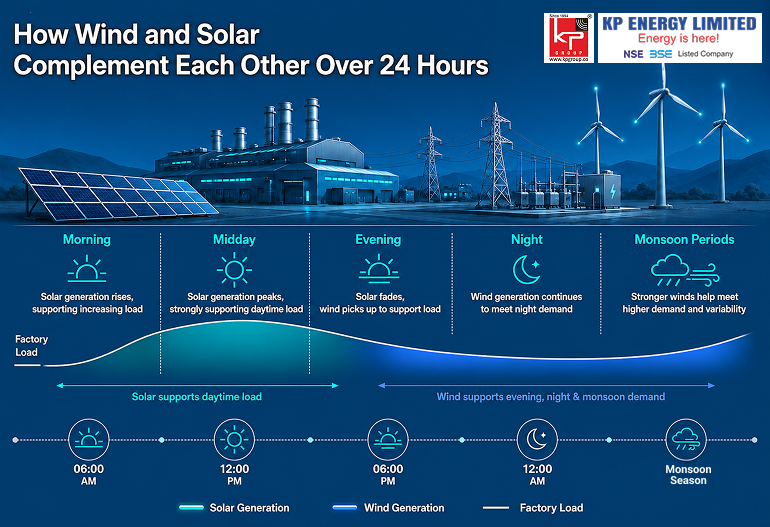
The main advantage of a solar and wind hybrid plant is the way both sources can complement each other.
|
Time or Period |
Likely Renewable Source |
Manufacturing Value |
|
Morning |
Solar generation begins increasing; wind may still be available |
Supports startup and early production loads |
|
Midday |
Solar generation is generally strongest |
Supports machining, processing and daytime operations |
|
Evening |
Solar output falls; wind may increase |
Helps support second shift demand |
|
Night |
Wind may continue generating |
Supports continuous or overnight processes |
|
Monsoon periods |
Wind generation may strengthen while solar output varies |
Improves seasonal generation balance |
|
Low resource periods |
Storage, grid power or backup may be required |
Maintains operational continuity |
This does not mean every hybrid project automatically provides uninterrupted renewable electricity throughout the year. Actual performance depends on site specific resources, project configuration and backup arrangements.
Nevertheless, wind and solar together generally improve renewable energy availability compared with either source operating independently.
Hybrid wind-solar systems support round-the-clock renewable energy by combining resources that generate during different periods.
Solar generation can stabilise daytime production, while wind generation may support evening, nighttime and monsoon period demand.
This can result in:
A smoother renewable energy supply curve
Lower reliance on peak hour grid electricity
Reduced use of diesel backup
Better support for continuous production
Improved energy planning
Greater operational predictability
Advanced forecasting and real time dispatch further improve industrial energy reliability with renewables.
Where battery storage is included, excess renewable power can be stored and used during periods of lower wind or solar output.
A genuinely uninterrupted renewable electricity supply depends on several project specific factors:
Strength of the local wind resource
Solar irradiation at the site
Seasonal weather variations
Factory demand during each shift
Battery capacity and discharge duration
Backup or grid connectivity
Transmission and evacuation infrastructure
Forecasting accuracy
Dispatch strategy
Plant maintenance and equipment availability
Every industrial site behaves differently. For that reason, hybrid project performance must be evaluated against the actual factory load curve rather than installed capacity alone.
Hybrid renewable energy can provide financial gains by maximising renewable electricity use across a greater portion of the day.
When solar and wind generation are combined, industries can reduce their dependence on:
High tariff grid electricity
Peak demand electricity
Diesel generator power
Unplanned backup arrangements
Short term power purchases
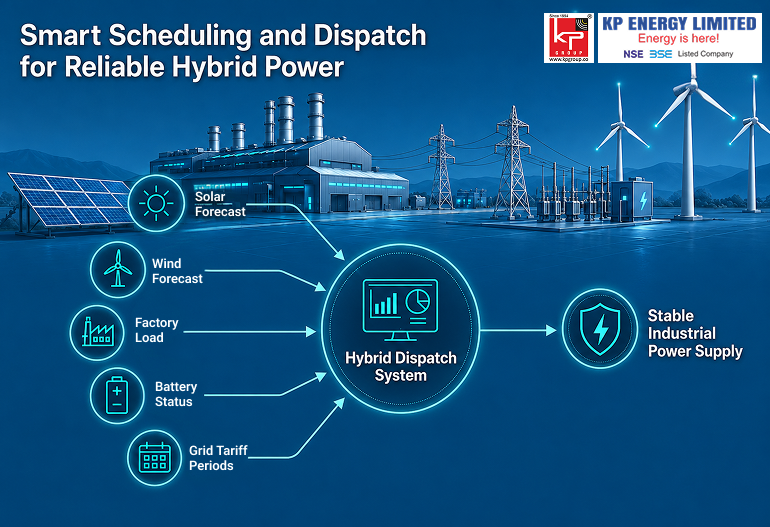
Many industrial facilities consume electricity continuously. Production cannot simply be stopped until renewable power becomes available again.
That is why hybrid plant scheduling and dispatch is central to project performance.
The system must allow each renewable source to operate when its resource is strongest while matching generation with industrial consumption.
Dispatch planning can consider:
Expected daytime solar irradiation
Forecast wind availability
Hourly industrial demand
Production shift schedules
Weather changes
Grid tariff periods
Battery state of charge
Equipment availability
Scheduled maintenance
Peak demand exposure
Modern dispatch platforms can integrate AI based forecasting models to predict weather related generation changes and adjust operating strategies.
This reduces the need for manual intervention and allows plant operators to respond faster to changing conditions.
|
Key Learning |
Explanation |
|
Complementarity supports continuity |
Solar serves daytime demand while wind may support evening, night and monsoon period loads |
|
Smart dispatch drives performance |
Forecasting and real time monitoring align generation with changing factory demand |
|
Storage strengthens reliability |
Batteries, where included, store surplus renewable electricity for later use |
|
Captive power improves control |
Industries receive renewable power through a project designed around their requirements |
|
Cost savings can be repeated |
Lower grid use, reduced diesel consumption and long-term tariff visibility improve economics |
|
Reliability improves operations |
Fewer voltage dips and power interruptions support smoother production |
|
Project design must be site specific |
Wind, solar, storage, grid conditions and factory load patterns vary by location |
|
Scale can be customised |
Hybrid projects can serve individual factories or large industrial consumers |
How does a hybrid wind-solar plant provide 24×7 renewable energy for manufacturing?
Hybrid plants offset the fluctuation of natural resources by mixing solar power production during the day with wind power usage at night or in the evening. As a result of good scheduling, forecasting, and optional storage/back-up, they are almost able to deliver continuous renewable energy adjusted to industrial load patterns.
What are the key benefits of using hybrid renewable energy systems in industrial plants?
On the one hand, industries obtain higher power availability, lower dependence on the grid, increased reliability, long-term cost stability, and a better sustainability profile. Besides, hybrid systems also alleviate the output variations that may arise from solar or wind only.
How do wind and solar complement each other in a hybrid power generation system?
Generally, solar is available during the day, while wind resources are typically stronger in the late evenings, nights, or monsoon periods. Therefore, this inherent complementarity results in a more even generation of 24 hours and 12 months, thereby increasing plant utilisation.
What performance metrics are essential for evaluating a hybrid solar-wind plant?
The most important indicators are availability factor, hourly generation stability, Plant Load Factor (PLF), resource complementarity index, following scheduled energy commitments, and cost per kWh delivered to the load.
How do hybrid renewable energy solutions help manufacturing plants save on energy costs?
They do so through the replacement of the most expensive modes of power consumption, e.g., grid or diesel, by the most predictable and clean power, i.e., low-tariff renewable power. The generation balance is better, and thus there is no production downtime and fewer operational losses, while long term PPAs protect the factories from rising grid tariffs.