Over the last decade, the wind energy industry has grown appreciably, with utility-scale wind Power purchase agreements projects cost now being competitive with conventional fossil fuel projects. However, undertaking development of a wind project requires a sufficient understanding of all possible financial components of the full investment. Cost Drivers in Utility-Scale Wind Projects describes several categories of costs, including costs associated with a pre-operational site assessment and feasibility, as well as ongoing operating costs.
Currently, wind farm projects tend to be sized between 50 megawatts (MW) and over 1,000 MW in generation capacity, and come with capital costs that range from hundreds of millions of dollars over the project’s life to possibly billions. The scale of these projects makes it a sound strategy to prepare an astute forecast while giving consideration to risk as an endeavor to ensure investment return sustainability and overall project sustainability.
Developers who learn the details related to utility-scale wind project costs will have important competitive advantages in bidding, securing financing, and managing projects. Understanding the cost drivers may lead to better:
Risk assessment and mitigation strategies
Project pricing and valuation
Decision-making in development
Negotiating with contractors and suppliers
Investor confidence and financing terms
Developers' capacity to foresee and control costs has an impact on the project's internal rate of return (IRR) and essentially establishes the value proposition of the project for development or investment. The nature of the technology, regulations, market structure, and so on creates an increasingly complicated and dynamic environment for developers to operate in.
Capital expenditure in wind energy projects generally comprise 70% to 80% of total lifetime project costs; therefore, the financing of developers will focus these investment costs. These costs are incurred upfront and include expenditures for anything required to move a project from conceptualization to commercial operation.
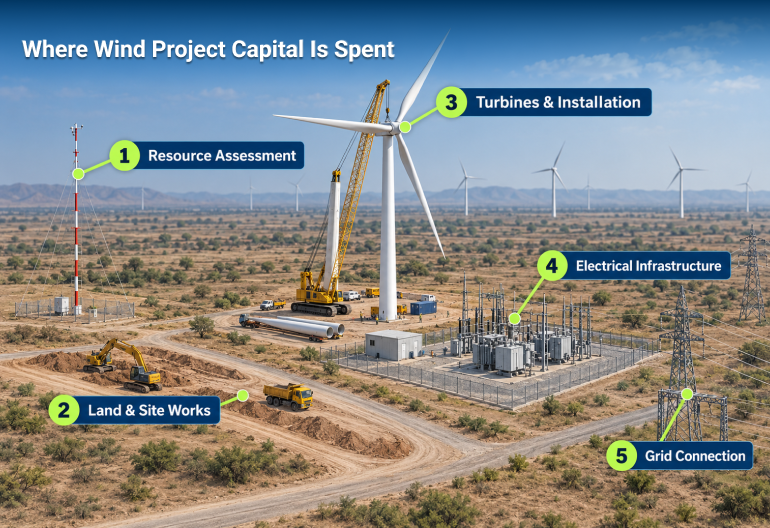
Wind turbines are the largest cost component of onshore wind projects, accounting for around 75% of installed costs. In India, total installed costs depend on:
Turbine technology and manufacturer
Hub height and rotor diameter specifications
Site-specific environmental conditions
Volume procurement advantages
Transportation and logistics requirements
Installation costs add around 10-15% to turbine procurement costs. These expenses encompass crane operations, construction of the foundation, electrical connections, and commissioning tasks. Installation costs can greatly increase with complicated terrains or remote sites.
Comprehensive wind resource assessment cost factors typically represent 1-3% of total project costs but critically influence long-term project viability. Key assessment components include:
Meteorological tower installation and monitoring equipment
LiDAR and SODAR measurement campaigns
Long-term data correlation studies
Wind flow modeling and turbulence analysis
Energy yield calculations and uncertainty assessments
Wind resource assessment campaigns typically require 12–24 months of on-site measurements to establish reliable wind conditions. . While representing a relatively small cost percentage, inadequate resource assessment can lead to significant revenue shortfalls over project lifetimes.
Land costs vary dramatically based on geographic location, land ownership structure, and local market conditions. Developers typically secure land through:
Direct purchase agreements
Long-term lease arrangements (20-40 years)
Option agreements during development phases
Easement rights for transmission corridors
Site development includes costs like land, civil works, transportation, and other pre-construction work. In India, CERC counts these under wind-project capital costs, which vary widely by project and location.
Balance of plant costs wind energy projects encompass all infrastructure components beyond the turbines themselves. These costs typically represent 20-30% of total capital expenditure in wind energy projects and include civil, electrical, and mechanical systems required for project operation.
Foundation costs vary with soil conditions, turbine size, and site-specific structural needs. CERC notes wind-project capital costs depend on location and size, while NIWE's Indian wind studies factor in soil type and turbine characteristics for foundation design.
Road construction and site preparation costs include:
Access road construction and maintenance
Crane pad preparation and reinforcement
Temporary construction facilities
Erosion control and environmental mitigation
Site restoration and landscaping
Civil works represent a significant component of wind project development, with requirements varying considerably based on topography, soil conditions and environmental constraints.
Electrical infrastructure represents a substantial portion of the balance of plant costs for wind energy projects. Major components include:
Medium-voltage collection system cables
Transformers and switching equipment
SCADA and communication systems
Meteorological monitoring equipment
Protective relay and control systems
Wind farms collect power from turbines via 33 kV overhead lines or underground cables, with costs depending on layout, voltage, and distance to the substation. Underground cabling costs more upfront; overhead lines need more upkeep.
On-site substations transform electricity from turbine voltage levels to transmission voltage for grid delivery. Substation costs varies depending on:
Voltage transformation requirements
Switching and protection equipment specifications
Real and reactive power control capabilities
Grid code compliance requirements
Future expansion considerations
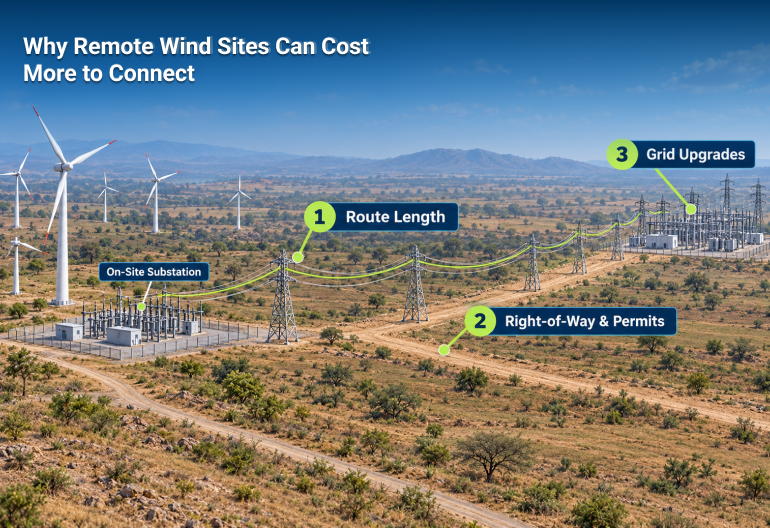
Grid connection agreements often require developers to fund transmission system upgrades, adding significant costs depending on existing infrastructure capacity and proximity.
Transmission and distribution costs of wind power can be challenging in wind energy projects because high quality wind resources are often located in remote areas. These costs can account for 10-25% of total project costs and can have a potentially large impact on project economics.
Grid integration challenges include:
Limited transmission capacity in rural areas
Voltage stability and power quality requirements
Intermittency management and grid balancing
Reactive power compensation needs
System protection and fault coordination
Developers must navigate complex interconnection studies and upgrade requirements that can extend development timelines and increase costs substantially.
Remote wind sites often require new transmission infrastructure to reach load centers. Long-distance transmission costs include:
New transmission line construction
Construction of new transmission lines
Acquisition of right-of-ways and permitting for environmental
System protection and communication equipment
Ongoing transmission service charges
Some projects require dedicated transmission lines spanning hundreds of miles, adding more substantial cost per MW to total project costs.
Wind project financing and investment have heavy implications for project development and cost optimization. Given that the financing costs, risk allocation decisions, and return levels will need to be understood and agreed upon with various stakeholders, a careful balancing act will also be required.
Traditional project finance structures combine 70-80% debt with 20-30% equity investments. Debt financing options include:
Bank term loans and revolving credit facilities
Tax equity partnerships utilizing production tax credits
Green bonds and sustainability-linked financing
Export credit agency financing for international projects
Development finance institution support
Equity investors seek returns of 12-20% IRR depending on project risk profiles and market conditions. Wind project financing and investment terms directly impact project viability and developer returns.
Government incentives significantly influence project economics through:
Tax credits for production and investment
Accelerated depreciation schedules
Renewable energy certificates (REC) and carbon credits
State regulations and environmental requirements for energy development
Power purchase agreements and feed-in tariffs
A stable policy environment, and the long-term visibility associated with the predictable policy-making processes related to utility regulation, creates environments for developers to obtain capital with favorable terms, or decreased premiums for risk management.
Investors evaluate multiple risk factors when assessing wind project financing and investment opportunities:
Resource and energy yield uncertainties
Technology performance and reliability risks
Regulatory and policy change exposure
Power market price volatility
Construction and operational risks
Comprehensive risk assessment and mitigation strategies enable developers to secure competitive financing terms and maximize project returns.
Cost optimization strategies in wind projects emphasize maximizing value for the project through technology, efficiencies, and development strategies. When experienced developers go through the development timeline they often optimize in multiple areas.
Recent technological developments significantly impact cost optimization strategies in wind projects:
Larger, more efficient turbines reducing per-MW installation costs
Advanced blade designs improving energy capture
Digital twin technologies optimizing performance
Predictive maintenance systems reducing operational expenses
Grid-forming inverters improving grid integration
These advances enable developers to achieve higher capacity factors while reducing levelized costs of energy.
Large-scale developments achieve significant cost advantages through:
Volume procurement discounts on turbines and components
Shared infrastructure costs across multiple turbines
Reduced per-MW development and permitting expenses
More efficient construction and logistics operations
Enhanced negotiating power with suppliers and contractors
Results from projects above 200-300 MW are most likely to realize economies of scale benefits.
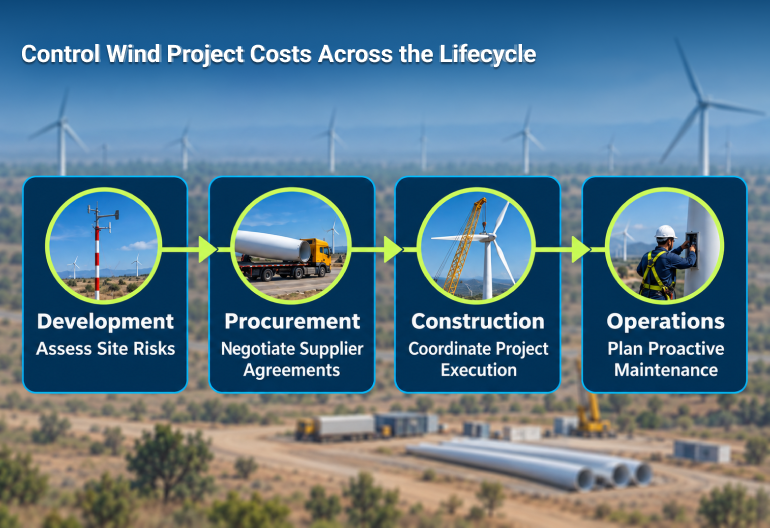
Developers can improve return on investment through:
Early stakeholder engagement and community relations
Comprehensive site characterization and optimization
Strategic supplier partnerships and long-term agreements
Integrated development and construction management
These practices reduce development risks, control costs, and enhance long-term project performance.
Understanding Cost Drivers in Utility-Scale Wind Projects is essential for successful project development in today's competitive renewable energy market. Developers who master the complexities of capital expenditure in wind energy projects, balance of plant costs wind energy, and transmission and distribution costs wind power gain significant competitive advantages.
For developers seeking end-to-end execution and tighter control over capital expenditure, KP Energy’s EPC & Construction (EPCC) services support wind projects from engineering and procurement to installation and commissioning, helping optimize costs across the project lifecycle
Applying cost optimization on wind projects will involve organized project development planning, advancements in technology and partnerships at all stages of the project development process. There's a competitive landscape determining the success of responding to multiple cost issues and identifying long-term operational performance and return on investment.
The wind sector is changing with new technologies and financial structures continuing to provide opportunities for more overall project cost reductions. Developers who remain aware of changes in the wind sector and have flexibility in financial and investing strategies as specific wind projects continue to evolve will remain well positioned for success in a changing market in the future.
What Is the Biggest Cost Driver in Utility-Scale Wind Projects?
Wind turbines account for 60-70% of project capital costs, covering the nacelle, tower, rotor, crane time, and installation, making optimized turbine procurement essential.
How Do Balance of Plant Costs Affect Profitability?
Optimizing the balance of plant costs, including civil works, electrical infrastructure, and grid connection, can raise project IRR by 1 to 3%, improving profitability and financing terms.
What Financing Models Work Best for Developers?
Effective wind financing pairs tax equity with debt, optimizing tax benefits and capital costs. Developer equity typically runs 20 to 30%.
Can Transmission Costs Be Reduced in Remote Wind Projects?
Wind transmission costs can be cut through project clustering, shared facilities, creative financing, favorable service agreements, or merchant transmission for long-term cost control.