India's renewable energy sector has seen unprecedented progress, with renewable energy auctions in India taking the lead as the primary means for deployment of capacity and through which prices are discovered. The country is now a global leader in clean energy deployment, driven by ambitious objectives and a continually evolving auction framework that remains a powerful mechanism that shifts the power generation ecosystem.
The change in auction-based processes has transformed how India's renewable energy policy operates, from historically fixed tariff regimes to competitive bidding processes economically. It has lead to significant tariff reductions and increased private sector participation that has made renewable energy projects the most economically viable they have ever been.
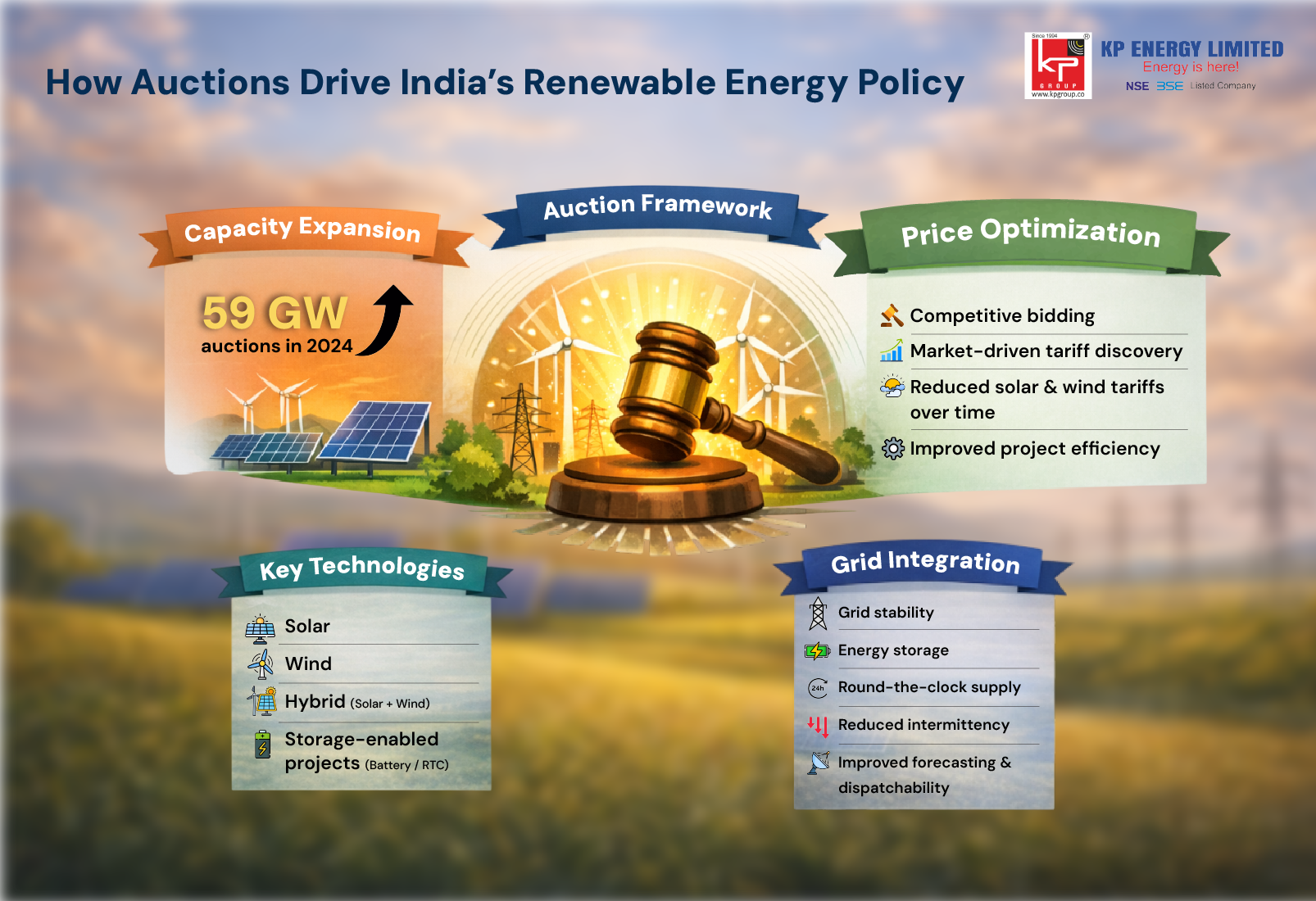
Renewable energy auctions in India are key to the country's strategy for transitioning to clean energy. These open processes of bidding have allowed government entities to discover tariff price rates with transparent allocation of renewable energy projects. India's clean energy auctions reached 59 GW in 2024, underscoring the scale and momentum of the auction process.
The auction framework has evolved to include different technologies and project configurations, from solar and wind standalone technology, to hybrid and storage-enabled technologies. This evolution is representative of the maturation of the renewable energy market, and the increasing sophistication of developers and policymakers to incorporate grid-integration challenges.
India's solar and wind energy auction landscape has changed remarkably over the past few years. The competitive bidding has repeatedly reduced tariffs while ramping up capacity additions in each technology.
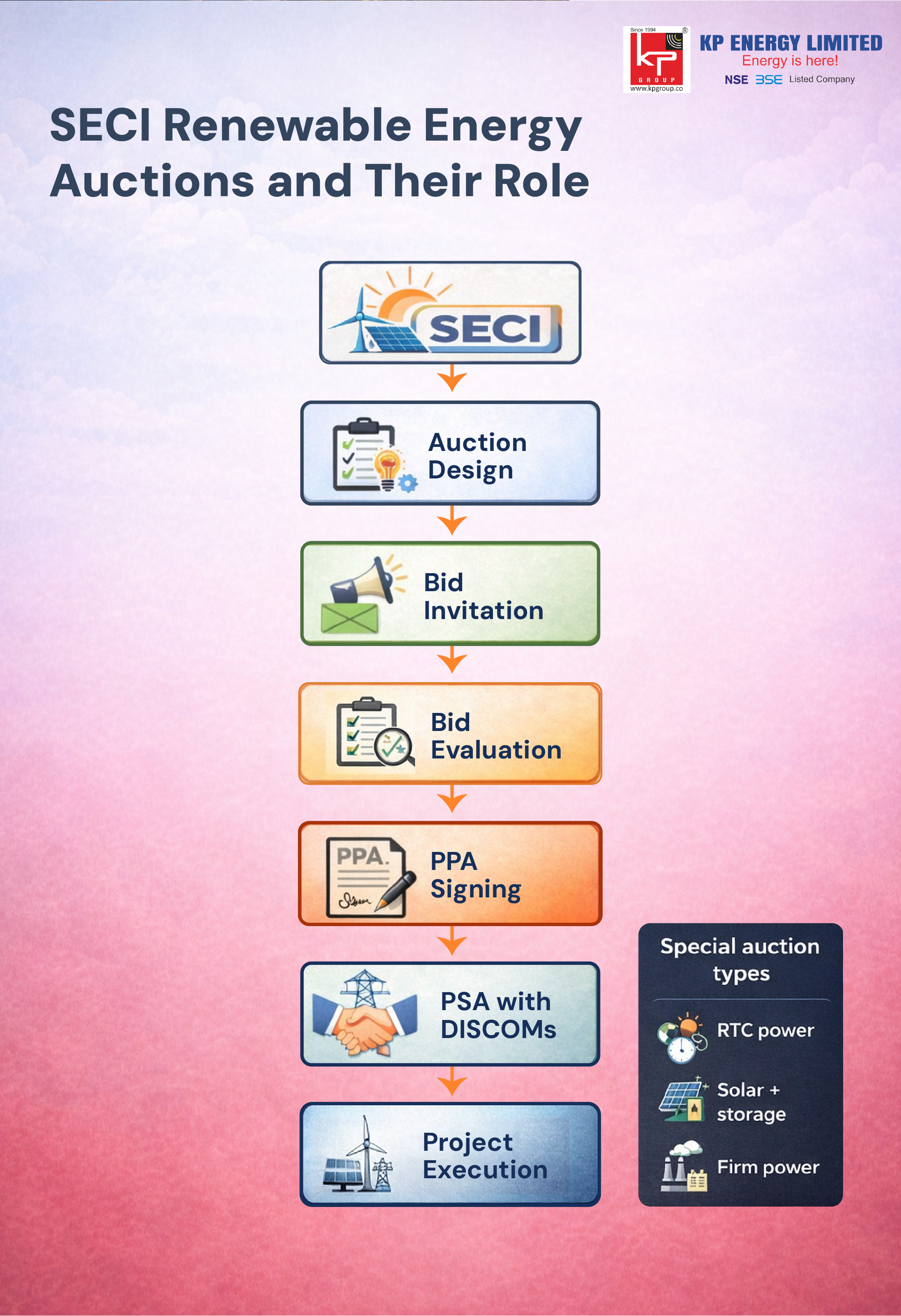
SECI renewable energy auctions is a key central implementing agency, but multiple state agencies (e.g., NTPC, GUVNL, MSEDCL, etc.) also conduct auctions. SECI, as one among the agencies for the National Solar Mission has run multiple successful auctions using multiple renewable technologies, and project configurations.
Furthermore, SECI has pioneered innovative auction formats like round-the-clock renewable energy supply and firming power auctions. SECI has also notably reduced tariffs on its most recent solar-plus-energy storage auctions with results showing competitive pricing for storage-integrated projects.
Hybrid renewable auctions in India are the next phase in the country's clean energy journey. The auction mode blends solar and wind technologies to utilize resources more efficiently and enhance grid stability through improved generation profiles.
The hybrid auction process allows for mitigating some of the inherent intermittency issues prevalent to each stand-alone renewable technology while improving capacity utilization factors. Recent solicitations have attracted a lot of interest from IPPs wanting to realize these technically challenging projects to obtain higher returns through better generation profiles.
The shifting auction environment provides ample new opportunities for IPPs to position themselves within India's renewable energy sector. The competitive nature of the market is challenging; however, for well-prepared developers with adequate technical expertise and financial backing, there can be substantial upside potential.
Solar-wind hybrid projects represent a robust opportunity for growth and longevity within the renewable energy space, as they entail complementary generation profiles to bring more uniform power output. Hybrid projects will require advanced levels of technical expertise, but their capacity utilization factors can be more favorable than single projects, possibly resulting in more revenue opportunity.
The Indian government is keen on hybrid projects and their ability to deliver, both for increased grid integration and land use benefits. IPPs with experience operating multiple renewable technologies are best suited to take advantage of this emerging vehicle.
Winners of a competitively bid auction generally enter into long-term Power Purchase Agreements (PPAs) with creditworthy offtakers which provide assurances and stability of revenue to support project financing. PPAs typically have a term of between 20 and 25 years and enable cash flows that are meaningful for equity partners and financial institutions.
The PPA structure associated with a competitively bid auction provides more security than other types of bilateral transactions, due to a government backstop, and more stringent payment security structure.
Notwithstanding its opportunities, risks in renewable energy projects in India - whether simple or multifaceted - continue to remain in significant counts. Independent Power Producers have to narrow down a wide variety of complications ranging from policies uncertainty to complications with execution.
Regulatory changes and unanticipated policy changes can continue to impact project economics as well as timelines for execution. Differences in renewable energy policies, grid codes, and approval processes at the state level add complexity for project developers that doing business across multiple states.
Along with the significant increase in renewable energy tendering and allotments expected after 2022, a significantly higher number of complications have also been observed with executing utility-scale renewable energy projects increasing the sector's execution risks.
Financing renewable energy projects India represents opportunities and challenges. Despite an influx of domestic and international capital to the sector, developers must navigate complex financing structures and generally changing market dynamics.
The economics of projects are influenced by rising interest rates, a changing regulatory environment for banks, and evolving criteria for credit assessment. Independent power producers (IPPs) must establish strong relationships with financial institutions and maintain solid balance sheets to receive financing on competitive terms.
IPP challenges in renewable energy projects are not just centered around financing; they also include land acquisition, regulatory approvals, and grid connection. In addition, competitive auctions have resulted in tighter margins, demanding a strong ability to execute projects and manage risk.
The time needed to develop a project has increased for a number of reasons including environmental permits, land acquisition issues, and grid infrastructure issues. IPPs are now required to incorporate these risks into their bidding strategies and project development timelines.
Role of DISCOMs in renewable energy auctions is critical to the success of the auction mechanism. Distribution companies serve as the ultimate offtakers for most auction-based renewable energy projects, making their financial health and operational efficiency crucial factors.
Distribution Companies (DISCOMs) are under enormous financial stress and struggling to meet power purchase obligations. The risk of power offtake delays and non-payment by DISCOMs remain key issue for Independent Power Producers (IPPs), affecting project economics and financing. Moreover, the sector continues to deal with high transmission and commercial losses, affecting financial sustainability.
The government has established a number of payment security mechanisms to alleviate creditworthiness concerns impacting DISCOMs. This includes payment security funds, letters of credit and aided guarantee structures intended to bring comfort to renewable energy developers.
The future of renewable energy auctions in India appears bright, with new auction formats emerging and increased emphasis on grid integration and energy storage. The sector will continue to innovate in auction design and project configurations.
Future capacity additions will increasingly need to address grid integration challenges, which will require planning sophisticated project designs and advanced technologies such as energy storage and grid balancing solutions.
Hybrid renewable auctions India will become more prevalent as grid integration challenges become more serious. Storage-linked auctions will become more commonplace to deal with the intermittent challenges from renewable energy integration.
The government is also working on new auction formats that bundle renewable generation with storage and transmission infrastructure, and are collectively part of building integrated solutions for grid restabilization and energy security.
The government is still reviewing the auction mechanism based on market feedback and the changing realities of the sector. The recent changes to the auction process have been largely focused on improving project bankability, lowering execution risk, and improving grid interconnection necessary to support the projects.
Future auction mechanics may incorporate more complex risk allocation methods, standardized development timelines and payment security, with the intent of generating more private sector participation in the process.
India's renewable energy auction system has matured into a robust framework that reconciles price-driven competition with project quality and requirements for grid integration. While significant IPP challenges in renewable energy projects persist, the opportunities for prepared developers will continue to grow as auction formats and policies evolve.
The success of the renewable energy auctions in India is linked to a stable policy environment, improved DISCOM financial viability, and progress on grid infrastructure development. As the sector continues to evolve toward more complex project configurations with hybrid and storage integrated solutions, IPPs will need increased development of technical capabilities and risk management opportunities.
The future of renewable energy auctions in India will be ultimately determined by the country's desire to achieve its set target of renewable energy capacity. Achieving the target will require ongoing momentum of auctions and project delivery across technologies and geography. IPPs that can adapt to the changing regulatory landscape while developing and delivering quality projects will be in a strong position to benefit from India's transformation to renewable energy.
How Do Renewable Energy Auctions Work in India?
Renewable energy auctions in India are a competitive bidding process, where developers place tariffs for a particular allocation of capacity. The successful bidders will be allocated the project subject to meeting technical and financial qualifications. The process enables transparent price discovery while assuring that certain quality standards are met in project delivery.
What Role Does SECI Play in Auctions?
SECI is the sole agency for implementation related to central government renewable energy auctions. The agency determines auction parameters, conducts the bidding process, evaluates submissions, and signs long-term power purchase agreements with the bidders. SECI also provides power sale agreements with the state DISCOMs and other off-takers.
What Are the Biggest Risks for IPPs in Renewable Energy Projects?
The primary risks include changes in policy and regulations, obtaining leasing the land to develop, delay in grid interconnection, a DISCOM default in payments, and changes in financing costs. Additionally, there are execution risks related to equipment supply chain delays, construction delays, and performance uncertainty that add to the risks of developers.
How Will Hybrid Renewable Auctions Shape the Future?
Hybrid renewables auctions will drive the next wave of growth to address grid integration challenges, and improve capacity utilization factors. They will also incentivize new technology and maximize resource use to provide more reliable generation.