

Solar panels stop producing the moment the sun drops. Wind often picks up exactly then. That mismatch, used well, is the basic idea behind solar wind hybrid systems for commercial and industrial consumers.
Solar wind hybrid systems combine solar and wind power to provide more consistent renewable energy for commercial and industrial consumers. They help reduce grid dependency, optimise land and transmission use, lower electricity costs, and support ESG goals.
This blog lays out what renewable energy solutions for industries actually deliver: steadier generation, less exposure to grid and fuel prices, smarter use of land and transmission, and a credible route to emissions targets. You will see how the two sources cover each other's weak hours, where the real savings sit, what reliability looks like without storage, and how the model is playing out across Indian industry right now.
A solar and wind hybrid power system in India runs photovoltaic panels and wind turbines into the same connection. The two rarely peak together, and that is the entire point.
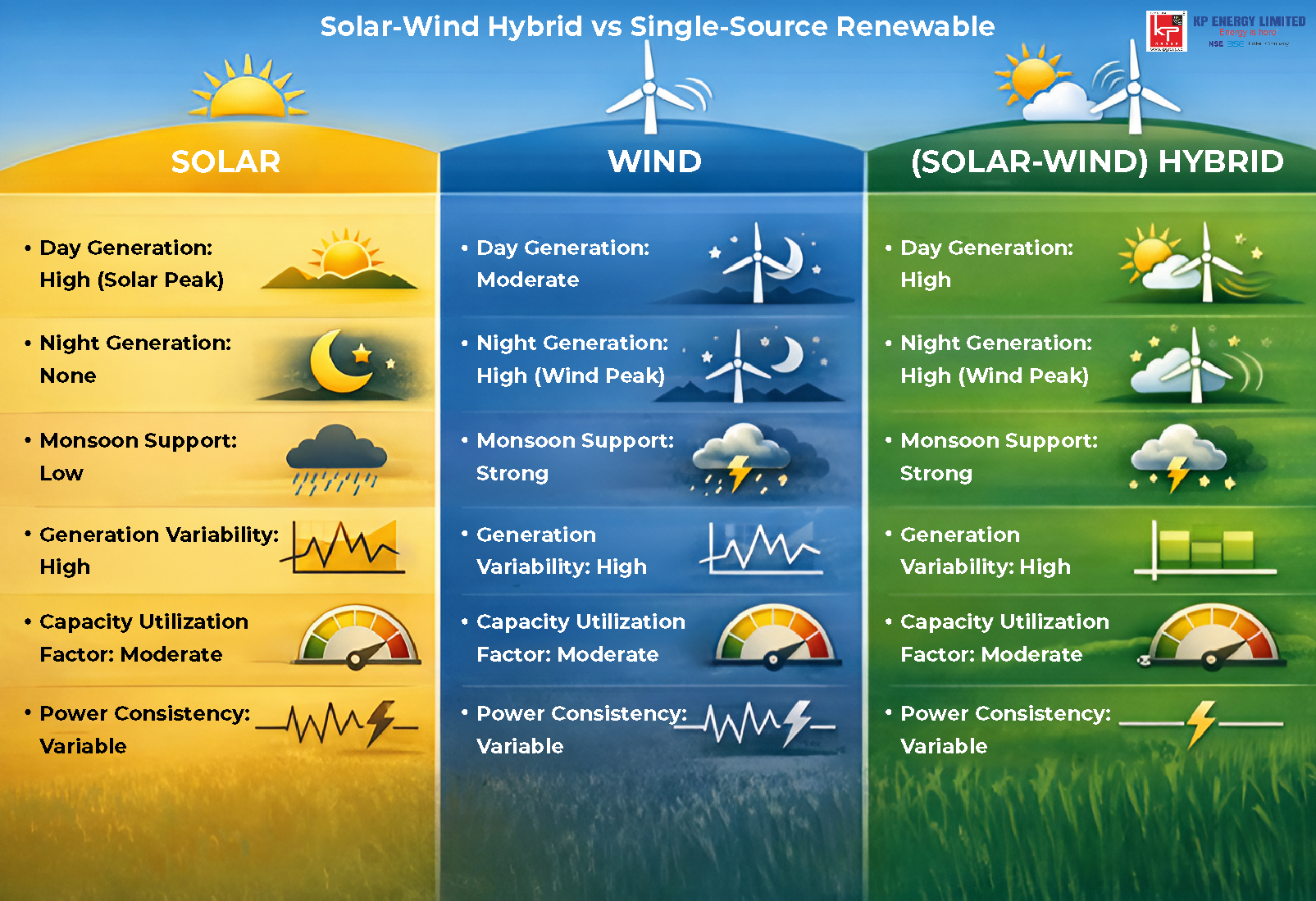
Solar carries the daytime load, strongest around midday.
Wind tends to step up at night and through the monsoon, when solar output falls away.
Both feed a shared grid or plant connection, with batteries added where supply has to stay constant.
Solar-wind hybrid power systems in India share a single power management system which helps in combining and balancing power generation from both solar and wind sources. This sharing of resources boosts the capacity utilisation factor Really more than if solar and wind were used separately. It is well suited to a country that has abundant sunlight throughout the year and winds that are strong only during certain seasons.
The benefits of solar-wind hybrid energy systems ultimately fall into three main categories: the level of power smoothness, the usage of the site, and how the company looks to regulators and investors.
Smoother generation: the production remains almost the same throughout the day and the seasons, enabling to decrease the dependence on the grid and the diesel.
Better use of land and grid: one site shares transmission lines, substations, and connection points, so more power comes off the same footprint.
Load that fits demand: generation can be shaped to follow a plant's real shift pattern, not a single fixed curve.
Less grid dependence: where supply is shaky, two reliable complementary sources keep more of the operation running through outages.
A cleaner compliance record: measurable emissions cuts support reporting duties and reassure customers and investors.
Stacked together, these solar-wind hybrid system advantages are why more industrial buyers now treat hybrids as the default option rather than the experiment.
The case for cost savings from hybrid renewable systems rests on one gap: industrial grid tariffs in India sit well above the cost of power a business generates for itself.
Lower energy bills: on-site generation sidesteps high commercial and industrial tariffs, which is where most of the saving comes from.
Less diesel: with enough storage, a hybrid trims or removes the diesel backup bill, fuel and upkeep included.
Tax and policy support: accelerated depreciation and capital incentives improve the economics and pull payback in.
A hedge on volatility: self-generation fixes a known cost while grid tariffs and fuel prices keep moving.
Higher asset value: sites with installed renewable generation tend to carry a premium.
|
Factor |
What it means for the business |
Typical range |
|
Electricity cost reduction |
Electricity cost reduction |
Around 40% to 70%, by system size and load covered |
|
Payback period |
Time to recover the upfront spend |
Roughly 4 to 6 years with accelerated depreciation |
|
Asset life |
Useful generating life of the equipment |
About 25 years for solar, 20 to 25 for wind |
|
Diesel backup |
Reliance on diesel gensets |
Reduced or removed with storage |
|
Price exposure |
Sensitivity to tariff and fuel swings |
Largely fixed once the system is built |
Energy reliability with solar-wind hybrid systems is the first thing most industrial buyers ask about, because an unplanned stop on a production line costs real money.
Two complementary sources cut the number of low-output hours, since wind often covers what solar cannot and the other way round. That improves reliability. It does not, on its own, guarantee power around the clock. True 24x7 supply still depends on battery storage, a grid connection, or both.
Closer to round the clock supply: complementary generation plus storage keeps hybrid power plants for industrial operations running through more of the day.
Lower transmission losses: generating onsite skips much of the loss that comes with grid-supplied power.
Steadier power quality: modern conditioning equipment holds voltage and frequency, which protects sensitive machinery.
Room to scale: capacity can be added in phases as demand grows, spreading the spend.
Real time monitoring: performance tracking flags maintenance early and keeps output where it should be.
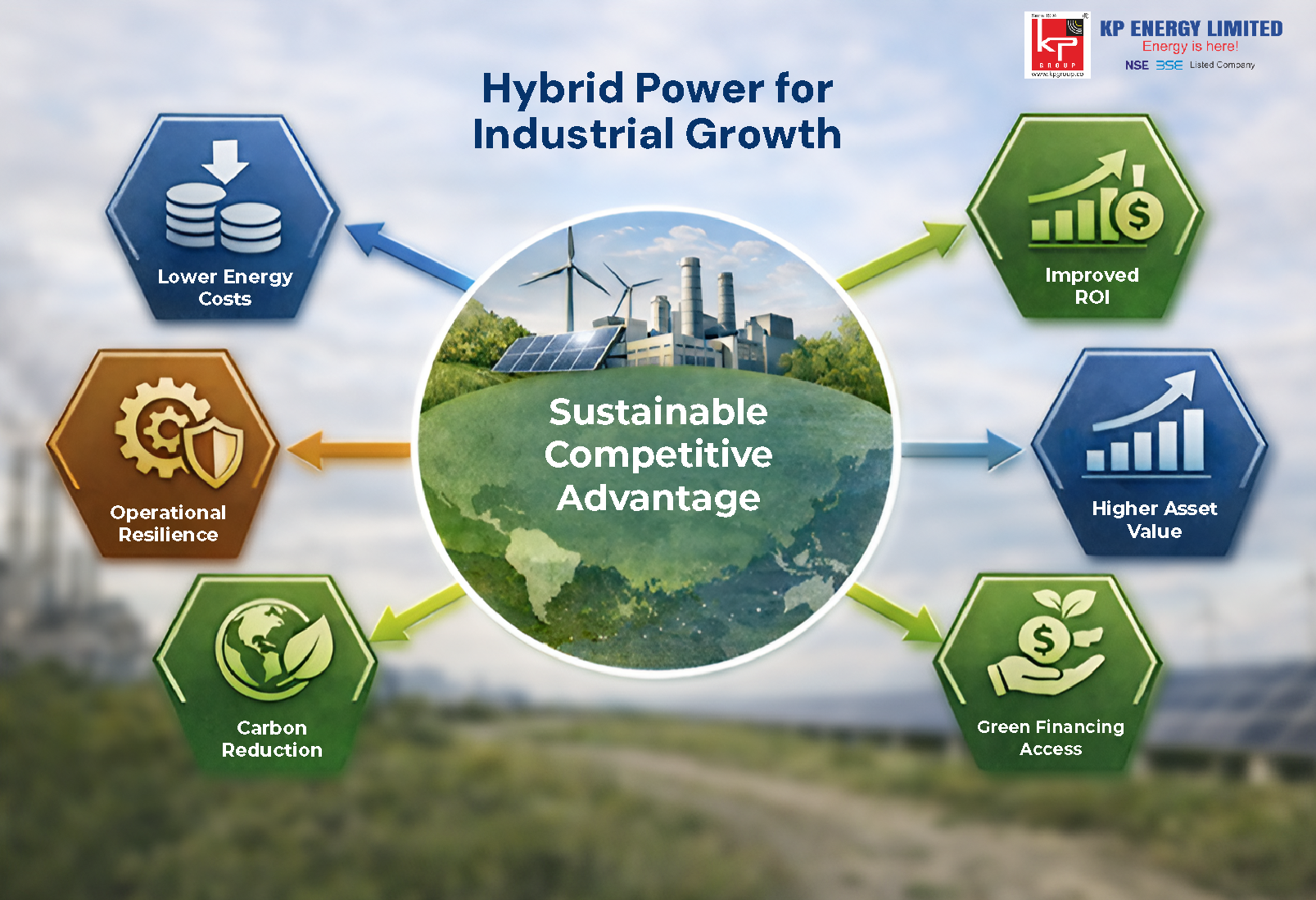
In today's marketplace, the notion of creating sustainable energy solutions for businesses has transitioned from a voluntary effort to one with competitive importance.
Investors, lenders, and large customers now read a company's emissions record the way they read its books.
Measurable, reportable cuts in greenhouse gas emissions back up ESG disclosures.
A clean generation record can ease access to green finance and lower regulatory scrutiny.
For many buyers, renewable energy for commercial and industrial use is now part of winning contracts, not just meeting targets.
Solar-wind hybrid projects in India have moved well past the pilot phase, with installations across the high resource corridors proving the model at both commercial and utility scale.
The National Wind-Solar Hybrid Policy, introduced by the Ministry of New and Renewable Energy in 2018, set the framework: a shared grid connection, a flexible wind to solar mix, and room to add battery storage and sell power through captive or open access routes.
Gujarat, Rajasthan, and Karnataka hold much of the current capacity, from commercial sites to large grid tied plants.
Industrial parks and special economic zones increasingly treat reliable clean power as a draw for serious tenants.
For an industry weighing the model, the usual entry point is a captive setup, where the business owns the generation feeding its own load. Reading through how a captive power plant works for industries helps frame that choice. KP Energy sits on the build side of this work as a wind EPCC and balance-of-plant specialist, with operations and maintenance and hybrid project development support, rather than full end to end solar delivery.
More consistent renewable generation
Better use of land and grid infrastructure
Reduced grid and diesel dependency
Lower long term electricity cost volatility
Stronger ESG and carbon reduction support
Power your business with KP Energy’s hybrid renewable solutions. Get a free consultation today!
For most industrial buyers the question is no longer whether hybrid generation makes sense, but how fast it can be folded into the energy plan. Predictable costs, steadier supply, and a defensible emissions record all push in the same direction.
Businesses moving on a hybrid build can bring in KP Energy for the wind EPCC, balance-of-plant, and project development support that shapes how the system gets built and run.
How Do Solar-Wind Hybrid Systems Work for Commercial and Industrial Applications?
Panels and turbines feed the same connection. Because solar peaks in the day while wind often strengthens at night and in the monsoon, the two cover each other's quiet hours, which is what makes the setup useful for steady industrial loads.
What are the major benefits of solar-wind hybrid systems for businesses?
Steadier output, lower electricity bills, less diesel, better power quality, and a stronger emissions record than either source delivers alone.
How Much Cost Savings Can Industries Achieve with Hybrid Renewable Systems?
Depending on system size, consumption pattern, tariff structure, and policy benefits, industries may achieve significant electricity cost savings, with payback varying from project to project.
Are Solar-Wind Hybrid Power Systems Suitable for Indian Industries?
They are. Strong year round sun and seasonal wind across states like Gujarat and Rajasthan make the country a natural fit, and the live project base keeps growing.
What Is the Future of Hybrid Renewable Energy Projects in India?
Momentum is building, helped by supportive policy and falling equipment costs. How quickly it scales from here depends less on whether the model works and more on how soon industries decide to commit.