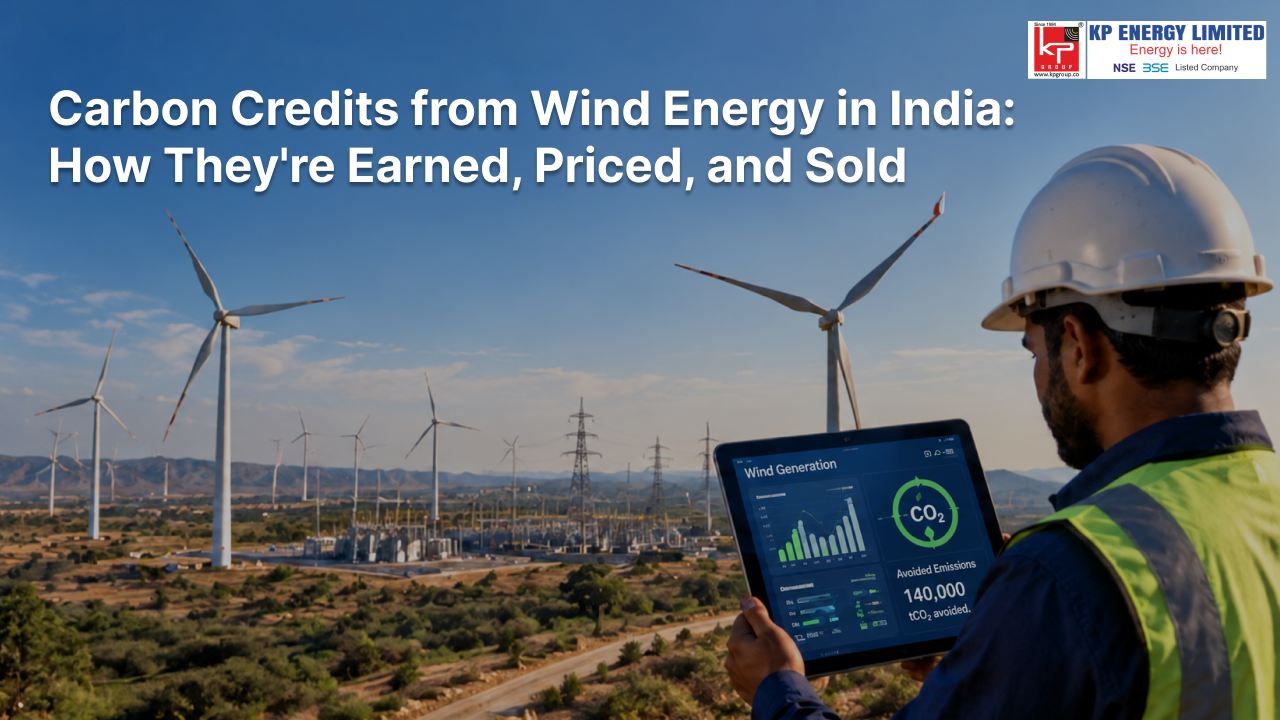
A 100 MW wind farm in Gujarat earns money in two ways most people never notice:
One is selling electricity.
The other way is earning money by getting credit for the carbon emissions it helps prevent.
That second revenue stream has a price, a registry, and now a real domestic market. This blog breaks down how carbon credits from wind energy projects in India actually work.
What they are
Why wind generates them
How they get certified
Who pays for them
What changed in 2026 (when India launched its own carbon market)
|
Element |
What it means |
|
1 carbon credit |
1 tonne of CO₂ (carbon dioxide) kept out of the atmosphere |
|
Who issues it in India |
Bureau of Energy Efficiency under the new national scheme |
|
Where it trades |
Indian power exchanges plus global voluntary markets |
|
Price range (2026) |
Depends on the type and the standard |
|
Who buys it |
Companies meeting net zero, ESG, or carbon import tax obligations |
A carbon credit is a receipt.
It certifies that one tonne of carbon dioxide either did not get released, or got pulled back out of the air, somewhere on the planet. A company that did release a tonne can buy that receipt to balance things out.
Two systems govern carbon credits in India:
Compliance market: government mandated. Heavy industries must cut emissions or buy credits to make up the gap.
Voluntary carbon market India runs in parallel. Companies buy credits by choice, usually to meet net zero pledges or ESG (Environmental, Social, Governance) goals.
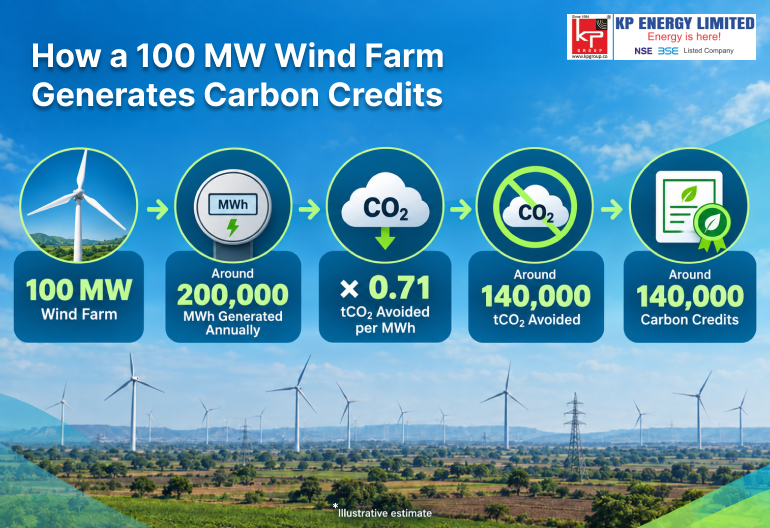
Every megawatt hour of wind electricity is one the grid did not have to generate from coal. India's grid emission factor sits at roughly 0.71 tonnes of CO₂ per megawatt hour (one MWh, or megawatt hour, runs about 330 average homes for an hour).
A 100 MW wind farm produces around 200,000 MWh a year. That works out to roughly 140,000 tonnes of CO₂ avoided annually.
Wind ranks high with buyers because the emissions cut is continuous, measurable, and verifiable. The deeper environmental conditions behind wind energy in India explains the science underlying that wind power carbon offset.
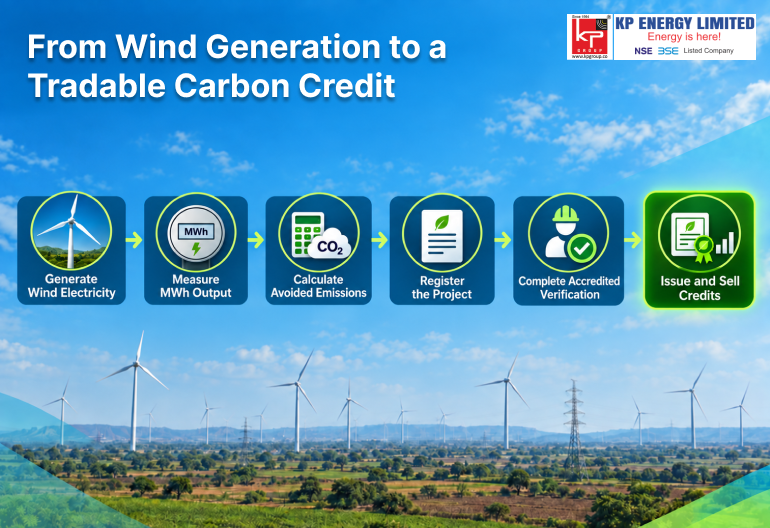
The route from a turbine to a tradable certificate:
Build the wind farm. Generate electricity.
Measure how much electricity was produced.
Calculate the carbon dioxide avoided using the grid factor.
Register the project under a recognised standard. International ones include Verra and Gold Standard. India now has its own.
An accredited auditor checks everything.
The project receives carbon credit certificates, one per tonne of carbon dioxide avoided.
Sell them on an exchange or to a direct buyer.
Before 2026, Indian wind projects mostly earned credits through old international systems. The main one was the CDM (Clean Development Mechanism), run by the United Nations.
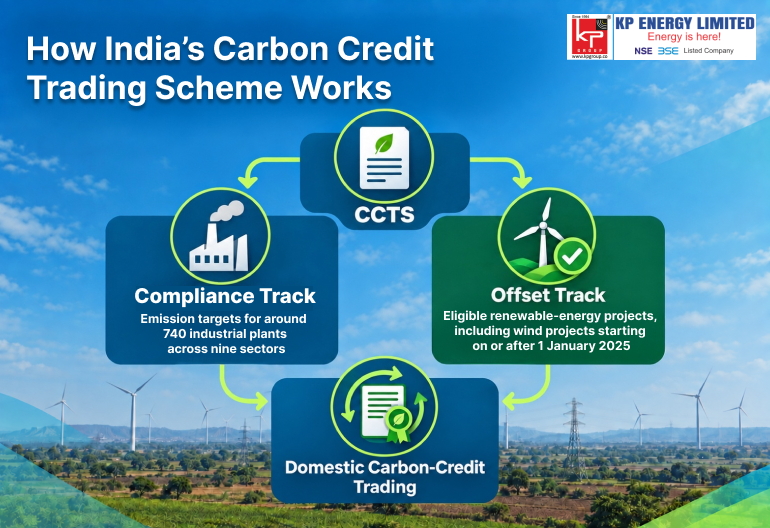
In 2026, India launched its own system. The carbon credit trading scheme India had been building since 2022 is now live. It is called CCTS, short for Carbon Credit Trading Scheme.
The Indian carbon market runs on two tracks:
Compliance track: Around 740 heavy industry plants across nine sectors must meet emission limits.
Offset track: This is where carbon credits for renewable energy projects sit, including wind. Projects must have started on or after January 1, 2025.
The offset side is the carbon offset mechanism India wind developers should now design projects around.
The offset side is the carbon offset mechanism in India, the wind developers should be watching.
|
Market type |
Price per tonne (₹) |
Typical buyer |
|
Voluntary (renewable energy) |
₹50–₹250/tCO₂e |
Indian corporates, multinationals |
|
CCTS compliance (forecast) |
₹600–₹1,200/tCO₂e (forecast) |
Heavy industries missing targets |
|
Premium nature based |
₹1,200–₹2,800+ |
ESG led global buyers |
Three main groups buy renewable energy carbon credits India generates:
Indian corporates chasing net zero targets, especially across IT, banking, and FMCG
Multinationals operating in India offsetting their local Scope 2 emissions
Indian exporters preparing for the EU's CBAM (Carbon Border Adjustment Mechanism), which from 2026 taxes imports into Europe based on their carbon footprint.
That last group matters most. Without a domestic carbon market, Indian exporters would pay carbon tariffs directly to Europe.
With CCTS in place, covered companies can increasingly manage their carbon costs within India’s own market, often cheaper. ESG compliance for Indian companies is no longer optional reporting. It is becoming an actual operating cost.
Carbon credits used to be a quiet side benefit for wind developers. They are now a second revenue stream worth designing into a project from day one. With the Indian carbon market live, the economics of every new wind farm has changed. Verification readiness, the unglamorous paperwork side, now compounds returns over a project's full lifetime.
For independent power producers, carbon credits can become a stronger revenue lever when wind projects are planned with generation efficiency, verification readiness, and long-term asset performance in mind. KP Energy supports independent power producers with end-to-end wind project development, from site planning and infrastructure to commissioning.
How much money does a wind farm actually earn from carbon credits in India?
A 100 MW wind farm generating around 140,000 carbon emission reduction credits a year could earn anywhere between ₹16 crore and ₹40 crore annually at current 2026 prices, depending on the certification standard, vintage, and buyer profile.
Can older wind projects still generate carbon credits under CCTS?
No. India's CCTS Offset Mechanism only accepts projects starting from January 1, 2025 onwards. Older wind projects can still sell into voluntary international markets through Verra or Gold Standard registries.
What is the difference between CCTS credits and voluntary credits?
CCTS credits are domestic, regulated by the Indian government, and recognised for compliance use. Voluntary credits are issued by international bodies and bought by companies pursuing net-zero pledges. Both are valid. CCTS credits will dominate domestic trading once the market matures.
Who verifies carbon credits from wind energy projects in India?
Accredited third party auditors. For CCTS, these are BEE approved verifiers. For international voluntary standards, Verra or Gold Standard accredited auditors. They check generation data, methodology, and emissions calculations before any carbon credit certificate India issues gets validated.
Are carbon credit earnings from wind energy taxable in India?
Tax treatment depends on the credit type and applicable provisions. Section 194 of the Income-tax Act, 2025 specifies a 10% rate for qualifying carbon-credit transfer income, without expenditure deductions. Its definition refers to UNFCCC-validated credits, so that treatment should not automatically be assumed for every CCTS or voluntary credit.